

The Air You Breathe
Medically Reviewed · May 2026
India's Air: The Invisible Epidemic Feeding Cance
13 of the world's 20 most polluted cities are in India. Air pollution is a Group 1 carcinogen — the same classification as cigarettes. Most Indians breathe it every single day without knowing what it is doing to their cells.
Dr. Vikesh Shah
MBBS MD · AIIMS New Delhi · ImmunoHope
Published May 2026 · immunohope.com · 7 min read
⚕ Medically Reviewed
References: IARC · WHO · ICMR · NICPR India · Not a substitute for medical advice
Group 1
WHO classification of outdoor air pollution - same tier as cigarettes and asbestos
Rising
Lung cancer in non-smoking Indian women — attributed to chronic pollution exposure
- Home
- Blog
- The Air You Breathe India's Air: The Invisible Epidemic Feeding Cancer
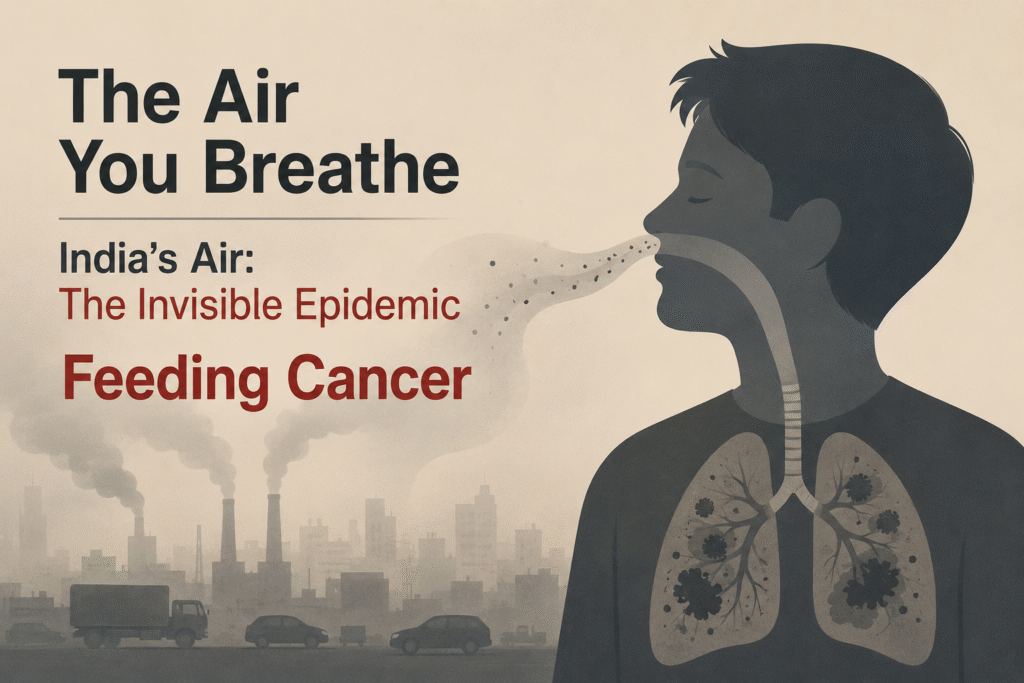
"Young women in Delhi who have never smoked are being diagnosed with lung cancer. The difference isn't genetics. It's the air they've been breathing for 30 years."
The Problem
Air Pollution Causes Cancer. That's Official.
The WHO classified outdoor air pollution as a Group 1 carcinogen—the same definitive category as cigarettes and asbestos. Not “possibly harmful.” Not “under investigation.” Confirmed. And India is home to 13 of the world’s 20 most polluted cities.
Most urban Indians are exposed to cancer-causing pollutants every day, whether they’re outdoors or inside poorly ventilated spaces. While a single day of exposure isn’t the concern, the cumulative impact over 20 to 30 years can significantly increase cancer risk. As awareness grows, advanced treatment options such as Immunotherapy in Ahmedabad are offering new hope for patients facing certain types of cancer.
What Is Actually in the Air You’re Breathing?
PM2.5
Particles fine enough to slip past your nose and throat and enter your bloodstream directly
Benzene
Released by vehicle exhaust — a confirmed cause of leukaemia
PAHs
Polycyclic aromatic hydrocarbons from open burning and industrial smoke
Heavy Metals
Arsenic, lead, cadmium from industrial areas and coal — accumulate in organs over time
NO₂ & Ozone
Damage lung tissue on contact and reduce the lungs’ ability to protect themselves
Where the Risk Comes From
The Four Main Sources
Vehicle Exhaust
Diesel trucks, buses, and autos are the biggest urban source of PM2.5 and benzene. On a two-wheeler, you are breathing it at exhaust level with no filter.
Open Burning
One hour of garbage burning 50 metres from your home releases more carcinogens than a full day of city traffic — especially if plastic or rubber is mixed in.
Industrial Emissions
Factories, brick kilns, and dyeing units near residential areas in Gujarat, Maharashtra, and UP create some of the highest localised carcinogen loads in the country.
Biomass Cooking Smoke
Wood, dung cakes, and coal burned daily for cooking in rural homes. The WHO links this directly to lung cancer — rural women are most affected, despite never smoking.
⚠ Your Commute Is a Daily Carcinogen Dose
Your 30–60 minutes in traffic — especially on a two-wheeler — is one of the highest daily pollution exposures most Indians get. Even inside a car in heavy traffic, exhaust gets pulled directly into the cabin.
✅ Switch car vents to recirculate in heavy traffic. On a two-wheeler, wear a real N95 mask — not a cloth mask. A cloth mask does not filter PM2.5.
Where You Live Matters
Living Near a Highway or Industrial Area
Homes within 300–500 metres of a busy highway face significantly elevated risks of lung cancer, bladder cancer, and childhood leukaemia. Diesel exhaust doesn’t just drift past — it settles. Night-time is worse: cool air traps pollution at ground level right when windows are open.
✅ Can’t relocate? Close highway-facing windows during peak hours. Run a HEPA air purifier in bedrooms. Plant a dense row of trees or shrubs as a buffer between your home and the road.
The Indoor Problem
Indoors Isn't Safe Either
In sealed buildings and biomass-cooking homes, indoor air is often 2–5 times more polluted than outside. A mosquito coil burning in a closed room releases particles equivalent to several cigarettes. Synthetic agarbatti release benzene and formaldehyde. Old paints and crumbling building materials in pre-2000 homes can shed lead and asbestos into the air you breathe every night.
✅ Ventilate every room for 30 minutes each morning. Switch to natural incense, citronella candles, and door nets. If your home was built before 2000, get it assessed before any drilling or renovation.
What You Can Do
Your Daily Air Protection Plan
🛡️ Ranked by Impact
HEPA air purifier in your bedroom — run it overnight.
You spend 7–8 hours there. This is the single highest-impact step for urban Indians — it cuts PM2.5 and VOC inhalation while you sleep.
N95 mask on two-wheelers and on high-AQI days.
Filters 95% of PM2.5. When AQI crosses 150, put it on before leaving home.
Open windows before 7am or after 9pm — not during rush hour.
This one habit change ventilates your home without pulling in peak traffic exhaust.
Never burn garbage, leaves, or crop stubble near your home.
And push back on neighbours who do. One fire undoes weeks of other protective steps.
Snake plant or peace lily on your desk and in your bedroom.
They absorb formaldehyde and benzene. Free, low-maintenance, and it actually works.
Frequently Asked Questions
What People Ask Most
Answered directly — based on WHO guidelines, IARC classifications, and peer-reviewed research.
Yes. The WHO classifies outdoor air pollution as a Group 1 carcinogen — meaning definite, confirmed evidence it causes cancer in humans. India is home to 13 of the 20 most polluted cities in the world. PM2.5, benzene, and PAHs from vehicle exhaust, open burning, and industry are inhaled daily by most urban Indians. Lung cancer in non-smokers is rising in Indian cities as a direct consequence.
Delhi, Kanpur, Lucknow, Varanasi, Patna, Faridabad, Gurugram, Noida, Ghaziabad, and Mumbai consistently rank among the most polluted globally. However, Tier 2 cities near industrial corridors — in Gujarat, Maharashtra, and Uttar Pradesh — often have higher localised carcinogen concentrations due to proximity to factories and brick kilns.
Yes — and indoor air can be 2–5 times more polluted than outdoor air in sealed buildings. Specific Indian indoor sources include biomass cooking smoke (a major cancer risk for rural women), mosquito coils in closed rooms, synthetic air fresheners, incense sticks in unventilated spaces, and VOCs from furniture and paints. Daily cross-ventilation is essential.
Yes. Living within 150–500 metres of a high-traffic highway significantly raises the risk of lung cancer, bladder cancer, and childhood leukaemia. Diesel exhaust contains dense concentrations of PM2.5, nitrogen dioxide, benzene, and PAHs. Night-time is most dangerous — cooler air traps pollution at ground level precisely when home windows are open.
An N95 filters at least 95% of airborne particles including PM2.5 — significantly more than cloth or surgical masks which offer minimal particle filtration. Wearing an N95 on a two-wheeler or on high-AQI days meaningfully reduces daily carcinogen inhalation. It does not filter gases like benzene, so a HEPA indoor purifier provides complementary protection indoors.
If you live in a polluted city: install a HEPA air purifier in your bedroom and run it overnight. This is where you spend the most continuous hours breathing. Pair this with N95 use on two-wheelers, keeping windows closed during peak traffic, and never burning garbage near your home. These four steps together dramatically reduce your cumulative carcinogen inhalation over a lifetime.
Dr. Vikesh Shah
MBBS MD · AIIMS New Delhi · Medical Reviewer, ImmunoHope
All risk assessments are based on WHO guidelines, IARC classifications, ICMR data, and peer-reviewed environmental oncology literature. This article is reviewed for accuracy and written specifically for Indian conditions.
What Else Is Silently Feeding Cancer in India?
The complete ImmunoHope Cancer Awareness Series covers every environment — your kitchen, home, office, and beyond.
MEDICAL DISCLAIMER
This article is published by ImmunoHope for general health awareness and educational purposes only. It is not a substitute for professional medical advice, diagnosis, or treatment.
If you have health concerns, unusual symptoms, or a family history of cancer, consult a qualified medical professional. In a medical emergency, contact your nearest hospital immediately.
Key References: WHO Air Quality Guidelines · IARC Monographs on Outdoor Air Pollution · ICMR National Cancer Registry Programme · Environmental Health Perspectives · Peer-reviewed occupational and environmental oncology literature.